Reel Labs and AutoReel both let real estate agents turn listing photos into marketing videos without hiring a videographer. Both support Zillow URL imports. Both promise to save you hours of editing.
But they take fundamentally different approaches — and the differences matter more than most review sites let on.
This is a direct, honest comparison. We built Reel Labs, so we're obviously biased. To compensate, we're going to be specific about where AutoReel wins, where we win, and where it genuinely depends on your situation.
The 60-Second Summary
| Reel Labs | AutoReel | |
|---|---|---|
| Price | Free / $29.9 per month | Free (watermarked) + paid plans |
| Cost per video | ~$2 | Not publicly listed |
| Generation time | ~2 minutes | 10-15 minutes |
| URL import | Zillow, Redfin, Realtor.com | Zillow, Realtor.com |
| AI voiceover | Yes (LLM-written script) | Yes |
| Beat-sync music | Yes | No |
| Drone simulation | No | Yes |
| Virtual staging | No | Yes |
| Post-gen editing | Full editor (drag, rewrite, re-render) | Limited |
| Output formats | 9:16, 16:9, 1:1 | Multiple |
| Max resolution | 1080p | Not specified |
| Modifies original photos | No | Yes |
Let's unpack each row.
Pricing and Cost Per Video
Reel Labs charges $29.9/month for the Pro plan, which includes 600 credits. A typical 45-second listing video costs around 15 credits, which works out to roughly $2 per video. The free tier gives you 60 credits per month to test the product — enough for a few videos without paying anything.
AutoReel has a free tier that adds a watermark to your videos. Paid plans exist but pricing isn't prominently listed on their site. The FAQ mentions plan tiers (Free, Growth, Pro) with varying image limits per video (15-20 images depending on plan).
Verdict: Reel Labs is more transparent on pricing. At ~$2 per video, you know exactly what you're spending. AutoReel's pricing requires you to sign up to see the actual numbers.
Generation Speed
This is one of the biggest practical differences.
Reel Labs: About 2 minutes from pasting a URL to having a finished video. The AI reads the listing, selects photos, writes a script, generates voiceover, syncs music, and renders — all in one pass.
AutoReel: 10-15 minutes per video. Part of this is because AutoReel does more processing per photo — generating drone simulations, AI enhancements, and virtual staging takes compute time.
Why this matters: If you have 8 active listings and want to create a video for each one, that's ~16 minutes with Reel Labs vs. ~2 hours with AutoReel. For agents who batch-create content on a Sunday evening, the speed difference is the difference between "quick task" and "whole evening project."
Verdict: Reel Labs is 5-7x faster. If you value speed and volume, this is a clear win.
The AI Photo Question
This is the biggest philosophical difference between the two products.
AutoReel uses AI to transform your listing photos in several ways:
- Drone simulation — Creates aerial fly-around perspectives from ground-level photos
- Virtual staging — Adds AI-generated furniture to empty rooms
- Photo enhancement — Converts daytime shots to twilight, repairs lawns, adjusts lighting
The results can look stunning. A basic suburban home can look like a luxury drone tour.
Reel Labs does not modify your listing photos. Your photographer's images appear exactly as they were delivered. The AI handles sequencing, transitions, script writing, voiceover, and music — but the photos themselves are untouched.
Why this matters for your business:
Here's a scenario. You use AutoReel to create a video with drone simulation and virtual staging for a vacant 3-bedroom listing. The video shows furnished rooms and aerial perspectives. A buyer watches it, gets excited, and schedules a showing.
They walk in. The rooms are empty. There's no furniture. The house looks nothing like the aerial fly-around because that perspective was AI-generated. The buyer's first words: "This doesn't look like the video."
You've now started the relationship on a credibility gap.
This isn't hypothetical. Virtual staging has been an industry practice for years, and most markets require disclosure. But when AI does it automatically — adding furniture, changing skies, creating perspectives that never existed — the disclosure burden falls on you, the agent. And many agents using these tools don't realize the extent of the modifications.
Reel Labs' position: We believe the agent's reputation is more valuable than a flashy video effect. The photos your buyer sees in the video should be the same property they see at the showing. No surprises.
AutoReel's position: AI enhancement makes properties more attractive in competitive markets, and virtual staging is an accepted industry practice.
Verdict: This depends on your values and your market. If your brand is built on transparency and trust, Reel Labs' approach aligns better. If you want maximum visual impact and your market accepts heavy AI enhancement, AutoReel delivers more dramatic results.
Post-Generation Editing
Reel Labs gives you a full video editor after generation. You can:
- Drag and rearrange clips on a timeline
- Edit the AI-written script (change wording, add details)
- Swap individual photos in and out
- Adjust voiceover timing
- Change music
- Re-render with your changes
This means the AI output is a starting point, not a final product. If the AI put the backyard shot too early, drag it to the end. If the script says "spacious kitchen" but you want "chef's kitchen with quartz countertops," just edit the text.
AutoReel offers more limited editing after generation. The FAQ mentions customization options, but the core workflow is designed around accepting the AI's output.
Why this matters: No AI gets it right 100% of the time. The ability to make quick adjustments without re-generating from scratch saves time and gives you control over the final result.
Verdict: Reel Labs wins on editing flexibility.
Content Types
This is where the two tools diverge significantly in scope.
AutoReel focuses on listing videos. You input a property, you get a listing video. It does that one job and does it with impressive visual effects (drone simulation in particular).
Reel Labs supports multiple content types from the same platform:
- Beat-sync listing videos — Fast cuts timed to music, optimized for TikTok/Reels
- Voiceover listing tours — AI narration walking through the property
- Community/neighborhood videos — Introduce the area around the listing
- School district videos — Nearby schools with ratings, grade levels, distances, and a visual map
- Weekly market reports — Automated data-driven video recaps for your farm area
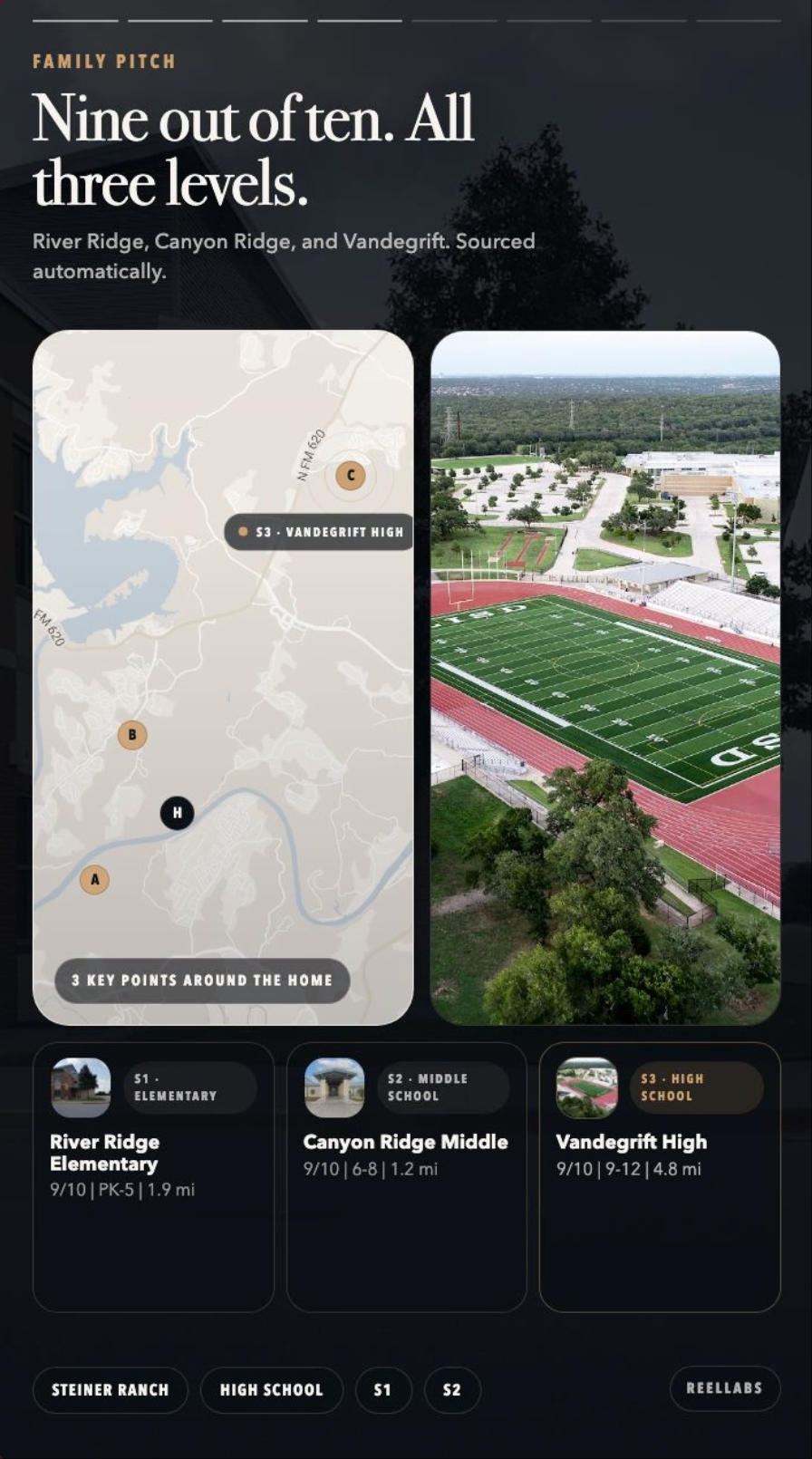
School district videos automatically pull nearby school data and create a visual map — content that families actively search for but few agents produce.
Why this matters: The agents winning on social media in 2026 aren't posting the same type of video over and over. They mix listing showcases with community content, school info, and market data. This variety:
- Gives the algorithm more types of content to test with different audiences
- Positions you as the local expert, not just "the agent who posts listings"
- Keeps your content calendar full even between listings
If all you need is listing videos, AutoReel does the job. If you want a content strategy that covers listings, community, education, and market data from one platform, Reel Labs offers more range.
Verdict: Reel Labs wins on content variety by a wide margin.
AI Script and Voiceover
Reel Labs uses a large language model to read the listing data and write a custom script. This isn't template-based ("Beautiful X-bedroom home..."). The LLM understands the property's selling points and writes copy that varies based on price point, property type, and neighborhood. The script drives an AI voiceover that sounds natural.
AutoReel also offers AI voiceover with multiple voice options. The scripting appears to be more template-driven than LLM-generated, but the output is functional.
Verdict: Reel Labs' LLM-written scripts feel more unique per property. AutoReel's voiceover is functional but more formulaic.
Visual Effects
Let's be fair here.
AutoReel wins on visual drama. The drone flythrough simulation is genuinely impressive. If visual spectacle is your priority and you're comfortable with AI-generated perspectives, AutoReel produces more visually dramatic output.
Reel Labs wins on audio-visual sync. Beat-sync transitions — where photo cuts land precisely on the music beat — create a polished, "edited" feeling that template-based transitions can't match. It's subtle but it's the difference between a video that feels produced and one that feels auto-generated.
Verdict: AutoReel for visual effects. Reel Labs for audio-visual polish.
Who Should Choose Reel Labs
- Agents who value speed and want to create videos for every listing, not just select ones
- Agents whose brand is built on trust and transparency — what you see is what you get
- Agents who want post-generation editing control
- Agents who need more than listing videos — community, school district, market report content
- Teams with high volume who need to batch-produce content affordably (~$2/video)
- Agents who post frequently (3-5x per week) and need a content pipeline, not a one-off tool
Who Should Choose AutoReel
- Agents who want drone-style visual effects without hiring a drone operator
- Agents who use virtual staging as part of their standard marketing
- Agents who prioritize visual drama over generation speed
- Agents in luxury markets where presentation expectations are highest and AI enhancement is accepted
- Agents who only need listing videos (not community/school/market content)
The Bottom Line
AutoReel and Reel Labs solve the same core problem — agents don't have time to manually edit listing videos — but they solve it differently.
AutoReel bets on making your photos look more impressive through AI transformation. Reel Labs bets on keeping your photos real and adding value through smart scripting, audio sync, editing flexibility, and content variety.
Neither approach is wrong. But they serve different kinds of agents.
If you try one listing video with each tool, the output will tell you which approach fits your brand.
Try Reel Labs free — paste a Zillow URL and see the result
FAQ
Can I use both tools for different listings?
Yes, but most agents prefer to standardize on one tool so their brand's video style stays consistent across all listings.
Does Reel Labs plan to add drone simulation?
Our roadmap focuses on content types (more data-driven videos, neighborhood content) rather than AI photo modification. Our design philosophy is to keep listing photos authentic.
Is AutoReel's virtual staging disclosed automatically?
You should verify this with AutoReel directly. As the listing agent, the disclosure obligation falls on you regardless of which tool adds the staging. Always check your local MLS rules.
Which tool is better for Instagram Reels vs TikTok?
Both tools output 9:16 vertical video suitable for Reels, TikTok, and Shorts. Reel Labs also supports 1:1 (Instagram feed) and 16:9 (YouTube/MLS). The platform you post on matters less than posting consistently.
I have 20+ active listings. Which is more practical?
At 20+ listings, speed and cost dominate the decision. Reel Labs at ~2 minutes and ~$2 per video means you can create all 20 in under an hour for ~$40. AutoReel at 10-15 minutes per video means 3-5 hours for the same batch.